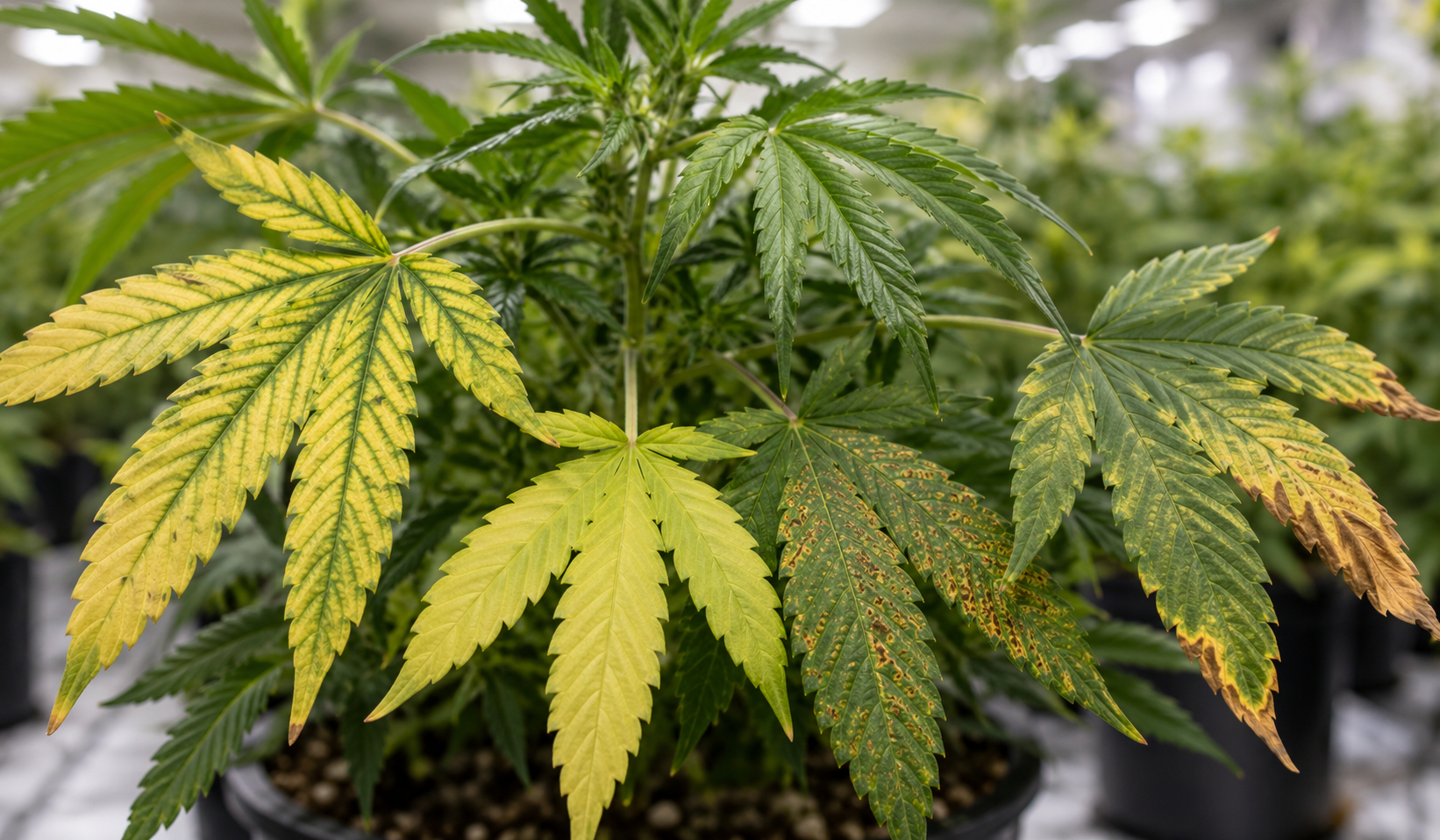
Cannabis leaves turning yellow can be a sign of natural aging, watering problems, nutrient stress, root issues, light stress, temperature changes, pests, or disease. Because several problems can produce similar yellow leaves, the location and pattern of the discoloration are important clues.
Before making changes to your plant, look at where the yellowing begins, how quickly it spreads, and whether symptoms such as curling, brown spots, drooping, or damaged leaf tips appear at the same time.
Here are 10 common reasons cannabis leaves may turn yellow and the clues that can help distinguish one problem from another.
1. Natural Aging of Older Cannabis Leaves
Not every yellow cannabis leaf signals a problem.
As plants mature, some of the oldest leaves near the lower part of the plant may naturally lose their green color. Plants continuously redistribute resources as new growth develops.
Natural aging is more likely when:
- Only a few lower leaves are affected
- Yellowing develops gradually
- New growth still appears healthy
- The rest of the plant maintains normal vigor
If yellowing becomes widespread or moves rapidly through the plant, another cause may be involved.
2. Cannabis Leaves Turning Yellow From Too Much Water
Excessive moisture is a common source of plant stress.
Roots require both water and oxygen. When the growing medium remains continuously saturated, oxygen availability around the root zone may decrease.
Possible signs include:
- Yellow or pale leaves
- Heavy-looking foliage
- Drooping
- Slow-looking growth
- Growing medium remaining wet for long periods
Overwatering can sometimes resemble a nutrient deficiency, which is why it is useful to examine moisture conditions before assuming that additional nutrients are needed.
3. Not Enough Water
Too little moisture may also cause cannabis leaves to become weak, dry, pale, or yellow.
Possible signs of insufficient moisture include:
- Dry growing medium
- Wilting
- Curled leaves
- Dry leaf edges
- Loss of plant vigor
Overwatering and underwatering can sometimes produce surprisingly similar leaf symptoms.
For that reason, look at both the foliage and the condition of the root environment.
4. Nitrogen-Related Yellowing
Nitrogen is closely connected with chlorophyll production and green vegetative growth.
When a plant has difficulty accessing sufficient nitrogen, yellowing often becomes noticeable on older leaves first.
The progression may appear as:
Green → Pale green → Yellow
However, yellow lower leaves do not automatically confirm a nitrogen deficiency.
Root stress, environmental problems, or nutrient-uptake issues can sometimes create similar symptoms even when nutrients are already present.
If you are researching deficiency symptoms, add an internal link here to your Cannabis Nutrient Deficiencies guide.
5. Magnesium-Related Symptoms
Magnesium plays an important role in photosynthesis.
When magnesium availability becomes limited, older leaves may develop yellow areas between greener veins.
Possible symptoms include:
- Interveinal yellowing
- Green veins with yellow tissue around them
- Rust-colored spotting
- Symptoms beginning on older foliage
This pattern can provide a useful clue, but several other plant-health problems can produce similar discoloration.
Evaluate leaf appearance together with root health, moisture, and the overall growing environment.
6. Root-Zone Problems and Nutrient Availability
Sometimes cannabis leaves turning yellow does not mean that nutrients are completely absent.
The root environment influences how effectively a plant can access available nutrients.
When roots are under stress, a plant may develop deficiency-like symptoms even when nutrients are present in the growing medium.
This is why automatically adding more fertilizer can sometimes make diagnosis more difficult.
Look at the plant as a whole and consider recent changes in watering, environmental conditions, and root-zone health.
7. Excessive Nutrients or Feeding Stress
More nutrients do not necessarily mean healthier plants.
Excessive nutrient levels may create stress that appears as:
- Damaged leaf tips
- Yellowing
- Browning
- Curling
- Unusually dark foliage
- Multiple symptoms appearing together
Leaf-tip damage combined with discoloration can be an important clue that the problem may not be a simple deficiency.
Avoid diagnosing a plant based only on the color yellow.
8. Light Stress
Light is essential for plant development, but excessive intensity may stress foliage.
When light-related stress occurs, symptoms may be more noticeable on the upper parts of the plant.
Watch for:
- Pale upper leaves
- Yellowing near the top
- Bleached-looking areas
- Curling
- Dry edges
- Changes in leaf texture
The location of the yellowing can be helpful.
If lower leaves remain relatively healthy while the upper canopy becomes pale, environmental conditions around the top of the plant may deserve closer attention.
9. Temperature Stress
Cannabis plants can respond visibly to unusually hot or cold conditions.
Heat may increase moisture loss and create stress, while cold conditions can slow normal plant processes.
Temperature-related symptoms may include:
- Yellow leaves
- Curling
- Drooping
- Reduced vigor
- Slow-looking development
Stable environmental conditions generally make plant-health problems easier to identify because fewer variables are changing simultaneously.
For additional plant-care information, internally link to your Growing Cannabis at Home guide here.
10. Pests or Plant Disease
Yellow spots, irregular patches, or rapidly spreading discoloration may sometimes be associated with pest or disease problems.
Some pests damage plant tissue directly, leaving pale or yellow marks.
Warning signs may include:
- Small yellow spots
- Irregular leaf damage
- Webbing
- Visible insects
- Unusual spotting
- Rapidly deteriorating foliage
Check both the upper and lower surfaces of affected leaves.
The pattern of damage is often more informative than the yellow color itself.
Cannabis Leaves Turning Yellow: How to Diagnose the Pattern
Before reacting to yellow foliage, examine the entire plant.
Ask yourself:
- Are only the oldest lower leaves yellow?
- Is the problem concentrated near the top?
- Is the yellowing uniform or between the veins?
- Are leaves also curling or drooping?
- Are leaf tips brown?
- Are there rust-colored spots?
- Has the moisture level changed recently?
- Did lighting or temperature conditions change?
- Are there visible insects or unusual marks?
- Is the problem spreading rapidly?
These observations can help narrow down the possible cause.
Quick Symptom Guide
Older lower leaves turning yellow:
May be associated with natural aging, nitrogen-related stress, or other root/environmental factors.
Yellowing between green veins:
May resemble magnesium-related symptoms.
Yellow upper leaves:
May be associated with light, environmental, or other plant-health stresses.
Yellow leaves with brown tips:
May indicate more than one type of plant stress.
Yellow spots with visible damage:
Inspect carefully for pests or disease.
Should You Remove Yellow Cannabis Leaves?
A completely dead or severely damaged leaf contributes little to normal plant function.
However, slight discoloration does not automatically mean a leaf needs to be removed.
Removing large amounts of foliage unnecessarily can create additional stress.
The more important question is:
Why did the leaf turn yellow?
Finding the underlying cause is usually more useful than focusing solely on removing the symptom.
Avoid Treating Every Yellow Leaf as a Nutrient Deficiency
One of the biggest mistakes when diagnosing yellow cannabis leaves is assuming that additional nutrients are always the answer.
Similar symptoms can result from:
- Too much water
- Too little water
- Root stress
- Environmental changes
- Light stress
- Temperature stress
- Excessive feeding
- Pests
- Natural plant aging
Understanding the pattern of symptoms can help avoid unnecessary changes.
Final Thoughts: Why Are Cannabis Leaves Turning Yellow?
Cannabis leaves turning yellow can result from several different conditions, including natural aging, moisture problems, nutrient-related stress, root issues, light, temperature, pests, and disease.
Instead of treating the first yellow leaf you see, examine the entire plant.
Pay particular attention to:
- Where symptoms begin
- Whether old or new leaves are affected
- How quickly the yellowing spreads
- Whether spots, curling, drooping, or damaged tips appear
- Whether environmental conditions have recently changed
Careful observation usually provides more useful information than leaf color alone.
Learning how to recognize these patterns can help you better understand cannabis plant health and distinguish normal plant changes from signs that deserve closer attention.
Frequently Asked Questions About Cannabis Leaves Turning Yellow
Why are the bottom cannabis leaves turning yellow?
A few older lower leaves may naturally yellow as a plant matures. Widespread lower-leaf yellowing can also be associated with moisture, nutrient-availability, root, or environmental issues.
Can overwatering cause cannabis leaves to turn yellow?
Yes. Constantly saturated growing conditions may reduce oxygen availability around the roots and contribute to yellow, pale, or drooping foliage.
Why are the top cannabis leaves turning yellow?
Yellowing concentrated around the upper portion of a plant may sometimes be associated with environmental conditions such as excessive light or heat, although other causes are also possible.
Are yellow cannabis leaves always caused by nutrient deficiency?
No. Watering, root stress, environmental conditions, natural aging, pests, disease, and excessive nutrient levels can produce similar symptoms.
Why are cannabis leaves yellow between the veins?
Interveinal yellowing can resemble magnesium-related symptoms, particularly when it begins on older foliage, but the overall plant and root environment should also be considered.
Should yellow cannabis leaves be removed?
Severely damaged or completely dead leaves may no longer contribute much to normal plant function, but slightly yellow leaves do not automatically need to be removed. Identifying the cause of the yellowing is more important.